


SXU Graduate SLP Students Present at Children's Museum
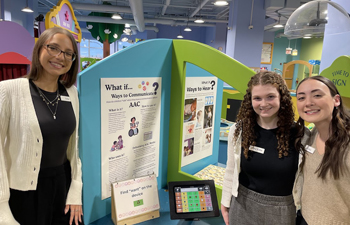
Saint Xavier University (SXU) graduate speech-language pathology students recently presented information on augmentative and alternative communication for an exhibit they created at the Children's Museum in Oak Lawn.
Augmentative and alternative communication (AAC) encompasses various methods of communication that extend beyond spoken language, including tools, systems and strategies designed to support or substitute speech for individuals facing communication difficulties due to conditions such as autism, cerebral palsy, stroke, or developmental delays.
Mary Kate Madden, Ashley Staszak and Julia Nalewajko, all of whom also attended Saint Xavier for their undergraduate studies, wanted to engage in a real-world, community-based experience as part of their graduate independent study course. With the help of Professor Melanie Greenspan, the group partnered with the Children's Museum to create a comprehensive presentation and exhibit for the community, families, and museum staff on augmentative and alternative communication and devices.
"We aimed to strengthen our understanding of AAC by learning how to explain foundational concepts, such as what AAC is, who it is for, and how it supports communication. Our hope is that the children will explore the communication device and become more comfortable using it, which can be helpful for future use or encounters with peers who use a device. We also hope that it will raise awareness," said Madden.
After an informative presentation, the students discussed their exhibit, reviewed facts and myths about AAC, and left time for questions.
"Participating in community events is important for students because it allows us to apply what we learn in class to real-world settings. Experiences like this help us understand that communication supports such as AAC are not limited to therapy rooms or classrooms but can be used in everyday community spaces to promote inclusion and accessibility," said Staszak.
The group is grateful for opportunities to grow as future speech-language pathology professionals, especially in collaboration, advocacy and professional communication. The students found that the experience encouraged them to think beyond traditional roles and recognize their responsibility to support inclusive communication across environments.
"This project encouraged us to think beyond the traditional clinic settings and consider how AAC can be implemented in community spaces. Presenting the device to the museum staff and community members highlighted the important role communication partners play in creating inclusive environments and supporting diverse communication needs, proving that accessibility is having the tools available but also ensuring that people understand how to use them," said Nalewajko.
The students look forward to seeing how AAC will impact the communication sciences and disorders field.
"AAC is a specialized part of speech-language pathology that is not yet well-known. It can be so powerful, and there is so much potential for AAC to become increasingly accessible. This project was a great way for us to see how we can make a real impact on the world as speech-language pathologists, which is just so encouraging and exciting as graduate students."